Auto-rickshaws are the backbone of last-mile urban transit across major Indian cities, accounting for over 40% of daily commercial CNG consumption. In metro hubs like Ahmedabad, Surat, Vadodara, Mumbai, and Delhi, understanding auto-rickshaw shift patterns is key to predicting urban station congestion.
Because commercial drivers follow structured multi-driver vehicle sharing models, station arrival patterns follow sharp, highly predictable daily spikes.
1. Dual-Shift Handover Windows: The Primary Congestion Cause
In Indian cities, an estimated 65% of auto-rickshaws operate on a dual-shift model where two independent drivers share a single vehicle over 24 hours:
- Day Shift: 6:00 AM to 2:00 PM
- Evening / Night Shift: 2:30 PM to 11:00 PM
Before handing over keys to the incoming driver, the outgoing shift driver is required to top off the CNG cylinder to 100% capacity. This contract rule creates intense queue surges at urban pumps between 1:30 PM – 3:00 PM and 10:00 PM – 11:30 PM.
2. Refueling Velocity: Why Auto Lines Clear Faster
While an auto-rickshaw line can look intimidating with 15 to 20 vehicles queued down the street, their refueling dynamics differ significantly from private cars:
- Small Cylinder Capacity: Standard 3-wheeler cylinders hold 3.5 kg to 4.5 kg of gas, requiring only 90 to 120 seconds of nozzle connection time.
- Experienced Driver Routine: Commercial drivers open access hoods, position fill valves, and process UPI payment with high efficiency.
- Line Throughput Rate: An auto-rickshaw lane often clears 20 vehicles in 25 minutes, whereas a 20-car private passenger line can take 45 to 55 minutes.
3. How Private Drivers Can Avoid Commercial Peak Rush
If you drive a private passenger car or ride-hailing cab, avoiding commercial shift windows is the easiest way to save time:
- Avoid visiting city center CNG pumps between 1:30 PM and 3:00 PM.
- Look for stations featuring physically separated light-vehicle lanes where cars do not queue behind commercial 3-wheelers.
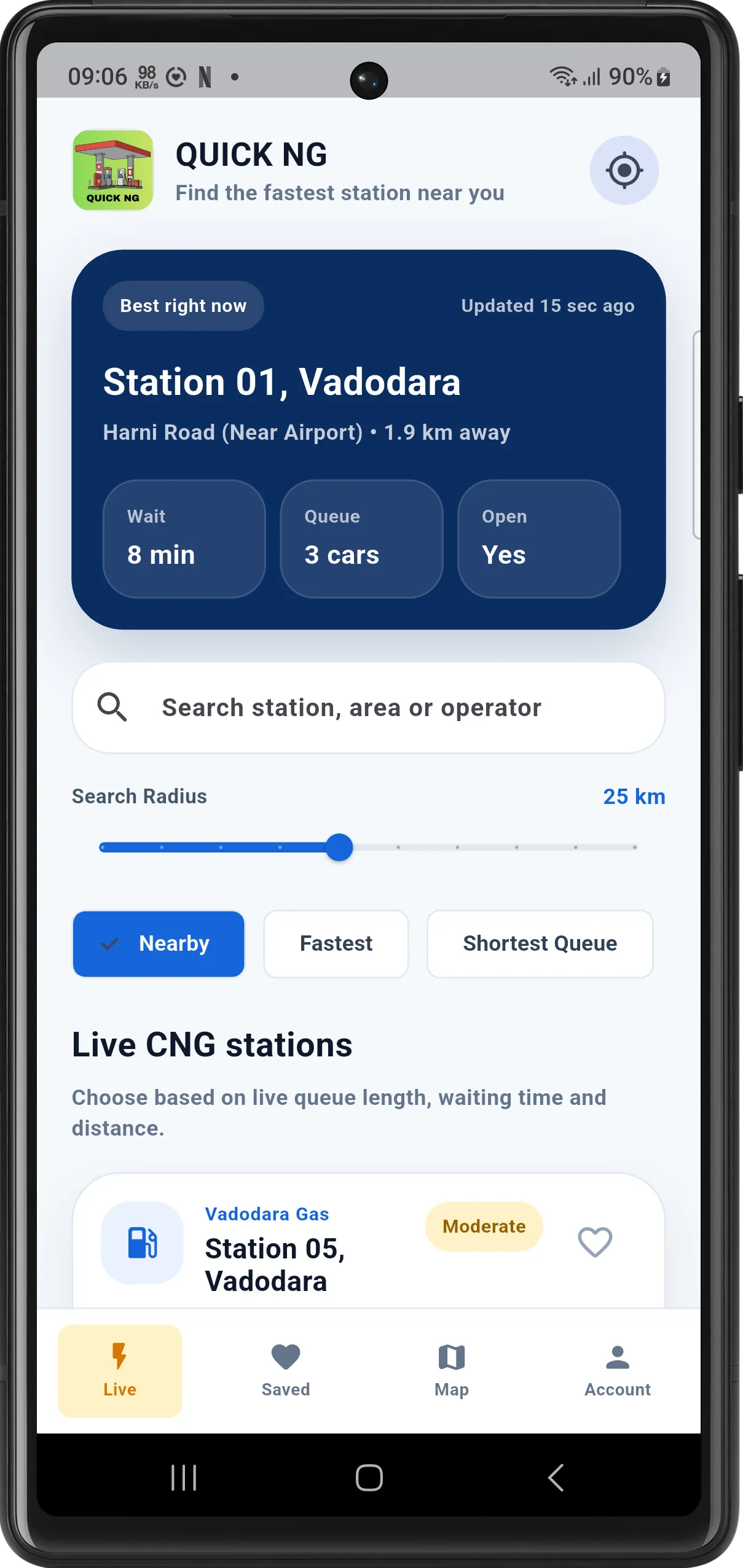
- Use QuickNG to check queue conditions before pulling into city-center pumps during afternoon hours.
🚕 Fleet Operation Tip
Visiting a station at 11:30 AM or 4:30 PM completely avoids both morning commute rushes and afternoon commercial shift handovers.